- Home
- Cruising Yachts 35' to 40'
- Beneteau Oceanis 381
The Beneteau Oceanis 381 Sailboat
Specs, Performance Analysis & Cruising Characteristics
Key Takeaways
The Beneteau Oceanis 381 is a good example of the late nineties cruising yacht, prioritising interior volume, cockpit ergonomics, and ease of handling over raw racing speed. Designed by the Berret-Racoupeau team, this light to moderate displacement sloop is widely regarded as an excellent coastal cruiser and a superb liveaboard for couples or small families. While its design ratios suggest a boat that requires a decent breeze to find its groove, its impressive form stability and bulb keel provide a reassuringly upright ride. Prospective owners should look for the 'Clipper' versions which often feature higher specification levels, though all models benefit from a hull shape that remains remarkably relevant in the modern second-hand market.
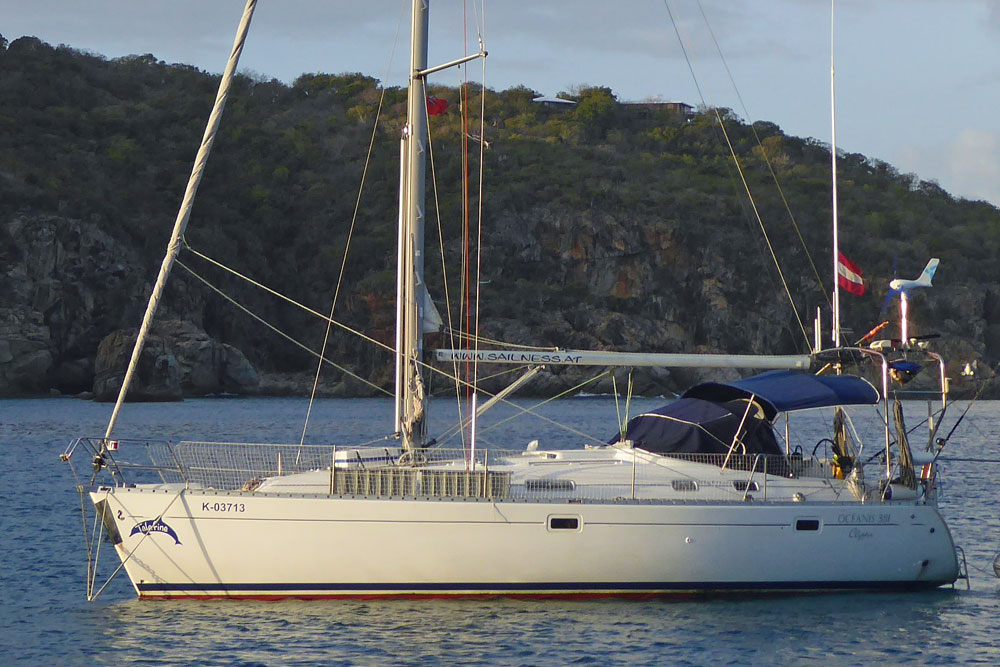 The Beneteau Oceanis 381
Design & Construction
The Beneteau Oceanis 381 was birthed from the collaboration between Beneteau, the world's largest sailboat manufacturer, and the naval architects at Berret-Racoupeau Yacht Design. Launched in 1996, the 381 was a successor to the earlier Oceanis models, aiming to refine the 'Clipper' philosophy of maximising living space without compromising the structural integrity required for offshore passages. The hull is constructed from solid, monolithic GRP (glass reinforced polyester) while the deck utilises a balsa sandwich core for superior stiffness and thermal insulation. This method of construction ensures a relatively low centre of gravity and a robust hull that has stood the test of time in both private use and charter fleets.
The key defining feature of the Oceanis 381 is its generous beam, which is carried well aft. This design choice serves two primary purposes: it creates a cavernous interior that rivals many 40-foot yachts and provides significant form stability. For the cruiser, this means the boat stays flatter for longer in building breezes, reducing crew fatigue and making life on board far more comfortable under sail. The 381 was produced in several configurations to suit different cruising grounds, including a standard deep fin keel with a bulb and a shoal draft version for those navigating thinner waters like the East Coast of England or the Bahamas. Most units were rigged as masthead sloops, though variations in interior layouts—offering either two or three cabins—allowed owners to choose between a palatial owner's version or a more versatile family layout.
Sail Areas & Rig Dimensions
The sail plan of the Beneteau Oceanis 381 is designed for simplicity and control. Most yachts were delivered with a large, furling genoa and either a classic slab-reefed mainsail or an in-mast furling system. The rig is a deck-stepped, masthead sloop with two sets of aft-swept spreaders, providing a stable platform for offshore work.
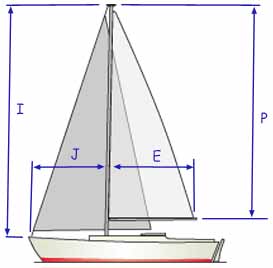
- Mainsail Area (Classic): 337'6" (31.36 m²)
- Genoa Area (100%): 413'3" (38.39 m²)
- Total Sail Area (100% Fore & Main): 750'4" (69.71 m²)
- I (Fore-triangle height): 45'5" (13.84 m)
- J (Fore-triangle base): 13'0" (3.96 m)
- P (Mainsail luff): 38'6" (11.73 m)
- E (Mainsail foot): 15'1" (4.60 m)
Published Specification: The Beneteau Oceanis 381 Blueprint
| Specification Parameter | Details & Measurements |
|---|---|
| Length Overall (LOA) | 38'7" (11.75 m) |
| Waterline Length (LWL) | 32'10" (10.01 m) |
| Beam | 12'11" (3.94 m) |
| Draft (Standard Keel) | 5'4" (1.62 m) |
| Draft (Shoal Keel) | 4'4" (1.32 m) |
| Displacement | 14,991 lb (6,800 kg) |
| Ballast (Cast Iron) | 4,740 lb (2,150 kg) |
| Rig Type | Masthead Sloop |
| Hull Material | Monolithic GRP |
| Production Dates | 1996 – 2002 |
Performance Analysis: Understanding the Design Ratios
To truly understand how the 381 behaves on the water, we must look beyond the aesthetics and into the mathematical heart of the design. These ratios provide a scientific basis for comparing the boat against its peers in the cruising market.
| Design Ratio | Calculated Value | Interpretation |
|---|---|---|
| Sail Area / Displacement (SA/D) | 19.7 | A healthy ratio for a cruiser, indicating the boat is powerful enough to perform well in moderate breezes. |
| Displacement / Length (D/L) | 189 | Classifies the boat as a light-moderate displacement yacht, suggesting it will be easily driven and responsive. |
| Ballast / Displacement (B/D) | 31.6% | A typical ratio for modern production boats; stiffness is largely derived from the hull's beam and the keel's bulb. |
| Capsize Screening Formula (CSF) | 2.09 | Positioned just above the 2.0 threshold, marking it as primarily a coastal and offshore cruiser rather than a dedicated ocean greyhound. |
| Brewer Motion Comfort Ratio | 22.1 | Indicates a motion that is relatively 'busy' in a seaway, common for light-displacement yachts with wide beams. |
For a deeper dive into how these figures impact your time at sea, refer to our guide on Understanding Boat Performance & Design Ratios.
The SA/D of 19.7 suggests that while the 381 is no racer, it is far from sluggish. However, the Displacement/Length ratio of 189 warns that the boat's performance is sensitive to weight. Loading it down with excessive cruising gear, heavy batteries, and full tanks will noticeably blunt its sailing edge. The Capsize Screening Formula of 2.09 indicates that while she is perfectly capable of crossing oceans in the right hands and conditions, the design prioritises the stability and volume required for coastal hopping and fair-weather passage making.
Structural Integrity & Stability Dynamics
The choice of monolithic GRP for the hull material is a testament to Beneteau's practical approach to maintenance and safety. Unlike sandwich constructions that can suffer from core delamination if water enters the laminate, the solid glass hull of the 381 is remarkably durable and relatively easy to repair should you have a minor 'interaction' with a quay or submerged object. This construction method also provides a sense of security during offshore passages, as the monolithic layup is less prone to the structural fatigue sometimes seen in lighter, high-tech composites.
When considering the key defining feature—the high form stability—one must recognise the trade-off. While the wide beam makes for a stiff boat in light to moderate air, it also means that the boat has a higher 'inverted stability' risk compared to narrow-beamed, traditional blue-water cruisers. However, for 95% of recreational sailors, the benefit of a boat that doesn't heel excessively at the first sign of a puff far outweighs the theoretical risks of extreme capsize scenarios. The bulb keel further enhances this by concentrating the ballast as low as possible, counteracting the leverage of the rig effectively.
Configuration, Layout & Cruising Characteristics
Step below and the Oceanis 381 reveals its true strength: an interior that feels significantly larger than its 38-foot designation. The saloon is bathed in light thanks to a generous number of opening ports and hatches, making it an airy and pleasant place to spend time. The galley is a highlight for the cruising chef, typically configured in a long 'linear' style to starboard or an L-shape, providing ample counter space and a large top-loading refrigerator.
Cruising practicalities have been well considered. The freshwater capacity is generous at roughly 480 litres (105 gallons), which is exceptional for a boat of this size and allows for extended stays at anchor without the immediate need for a watermaker. The fuel tank, usually around 150 litres (33 gallons), provides a motoring range of approximately 250 to 300 nautical miles, depending on the engine choice—most commonly a Yanmar or Westerbeke diesel in the 30 to 42 horsepower range.
The cockpit is another area where Beneteau's experience shines. It is designed for socialising, with a large permanent table and clear walk-through access to the transom. The 'scoop' stern with a folding ladder makes swimming and boarding from a dinghy effortless, a feature that owners in warmer climates find indispensable. While the steering is managed via a single large wheel, the helm position offers excellent visibility forward, although some sailors might find the large cockpit a little too open during heavy weather.
Impressed?

Has this article may suggested that this could be your ideal cruising boat and, as a result, deserves to be on your "Worth a look at" list?
But if, like me, you find sailboats to be seductive creations, then that list could rapidly get to be a pretty long one. If that is the case, wouldn't it be good if you could narrow it down bit through an objective, pragmatic process?
Well, that's where my eBook 'How to Avoid Buying the Wrong Sailboat' comes in...
Summing Up
The Beneteau Oceanis 381 remains a compelling choice for the modern coastal cruiser. Its design ratios paint a picture of a boat that is balanced—nimble enough to enjoy a weekend sail but substantial enough to provide a stable platform for summer holidays. While it lacks the ultimate heavy-weather comfort of a heavy-displacement cutter, it more than makes up for it with its light-air responsiveness and legendary interior volume. Maintenance is generally straightforward due to the monolithic GRP construction, though prospective buyers should pay close attention to the condition of the balsa-cored decks and the keel-to-hull joint. Ultimately, if your cruising goals involve comfortable coastal passages, entertaining friends, and a bright, functional living space, the 381 is a design that is very hard to beat.
If you'd like to compare this boat with others in this size range, take a look at Cruising Sailboats from 35' to 40' Overall...
This article was written by Dick McClary, RYA Yachtmaster and author of the RYA publications 'Offshore Sailing' and 'Fishing Afloat', member of The Yachting Journalists Association (YJA), and erstwhile member of the Ocean Cruising Club (OCC).
Frequently Asked Questions (FAQs)
How does the shoal draft version compare to the standard keel?
How does the shoal draft version compare to the standard keel?
The shoal draft version (4'4") allows access to many more anchorages but comes with a slight penalty in upwind performance. You will find that the boat makes more leeway (slides sideways) when sailing close-hauled compared to the standard 5'4" keel.
Is the Beneteau Oceanis 381 suitable for single-handed sailing?
Is the Beneteau Oceanis 381 suitable for single-handed sailing?
Yes, the 381 is well-suited to solo or short-handed sailing. All major control lines are led aft to the cockpit, and the high form stability means the boat is forgiving in gusts. If equipped with in-mast furling, sail handling becomes even more manageable from the safety of the cockpit.
What are the common maintenance issues to look for?
What are the common maintenance issues to look for?
Like many boats of this era, check for 'crazing' in the gelcoat and signs of moisture in the balsa-cored deck around high-load fittings. Also, inspect the rudder bearings and the engine's heat exchanger, as these are standard wear items for a yacht of this age.
Can the 381 handle an Atlantic crossing?
Can the 381 handle an Atlantic crossing?
While designed as a Category A (Ocean) vessel, the 381 is optimised for coastal cruising. Many have successfully crossed the Atlantic in the ARC (Atlantic Rally for Cruisers), but it requires careful preparation, especially regarding stowage of heavy gear to maintain the boat's stability and performance.
What is the difference between the 2-cabin and 3-cabin layouts?
What is the difference between the 2-cabin and 3-cabin layouts?
The 2-cabin version is the 'owner's version,' featuring a larger aft cabin and often a more spacious heads compartment. The 3-cabin version splits the aft section into two identical double cabins, which is ideal for families or those who frequently have guests on board.
Recent Articles


-
Mystery 35 Review: Specs, Performance & Buying Guide
Aug 29, 26 09:42 AM
An in-depth review of the Mystery 35 sailboat. Read technical specs, design ratios, sail performance, and common buyer inspection areas. -
Beneteau First 405 Review: Specs, Performance & Buyer’s Guide
Aug 26, 26 03:58 AM
Detailed Beneteau First 405 review covering specs, performance, bluewater capability, layouts and buyer’s checklist. -
Moody S38 Review: Specs, Ratios & Buyer’s Guide
Aug 12, 26 04:22 AM
In‑depth Moody S38 review covering specs, performance, design ratios, layout, strengths, trade‑offs & buyer inspection points.