- Home
- Cruising Yachts 40' to 45'
- Island Packet 445 Review
The Island Packet 445 Sailboat
Specs & Key Performance Indicators
Key Takeaways: The Island Packet 445 is a full‑keel, centre‑cockpit cutter aimed squarely at long‑distance cruising rather than coastal pottering or club racing. She is heavy, strongly built and optimised for comfort, load‑carrying and predictable behaviour in a seaway, not for light‑air sparkle. The design ratios, tankage and interior layout all point towards couples or families planning extended time aboard who value security, storage and easy motion more than outright speed. The trade‑offs are obvious: modest performance in light airs, a deep‑draft full keel that limits skinny‑water exploration, and age‑related maintenance items that now need attention on most examples. Handled with realistic expectations, she is a serious bluewater home rather than a weekender.
Table of Contents
- The Island Packet 445 at a Glance
- Design & Construction
- Published Specification: The Island Packet 445 Blueprint
- Sail Areas & Rig Dimensions
- Performance Analysis: Understanding the Design Ratios
- How the Island Packet 445 Sails
- Bluewater Capability: Strengths & Trade-Offs
- Configuration, Layout & Cruising Characteristics
- Who This Boat Is Best For
- The Buyer’s Checklist: Common Problem Areas
- Summing Up
- Frequently Asked Questions (FAQs)
The Island Packet 445 at a Glance
- Type: Bluewater cruising monohull, centre‑cockpit, long‑keel cutter
- Designer: Bob Johnson, Island Packet Yachts
- Builder: Island Packet Yachts, Largo, Florida, USA
- Production Years: 2004–2015
- Rig: Cutter, masthead, in‑mast furling main on most boats
- Best for: Couples or families planning extended offshore passages and liveaboard cruising who prioritise comfort, storage and rugged construction over speed
- Strengths: Full‑keel tracking, protected rudder, generous tankage, secure centre cockpit, spacious interior, strong owner community, good motion comfort
- Trade‑offs: Modest light‑air performance, relatively deep draft for a full‑keel boat, heavy displacement, age‑related issues (tanks, chainplates, portlights, systems) now entering the refit window
Design & Construction
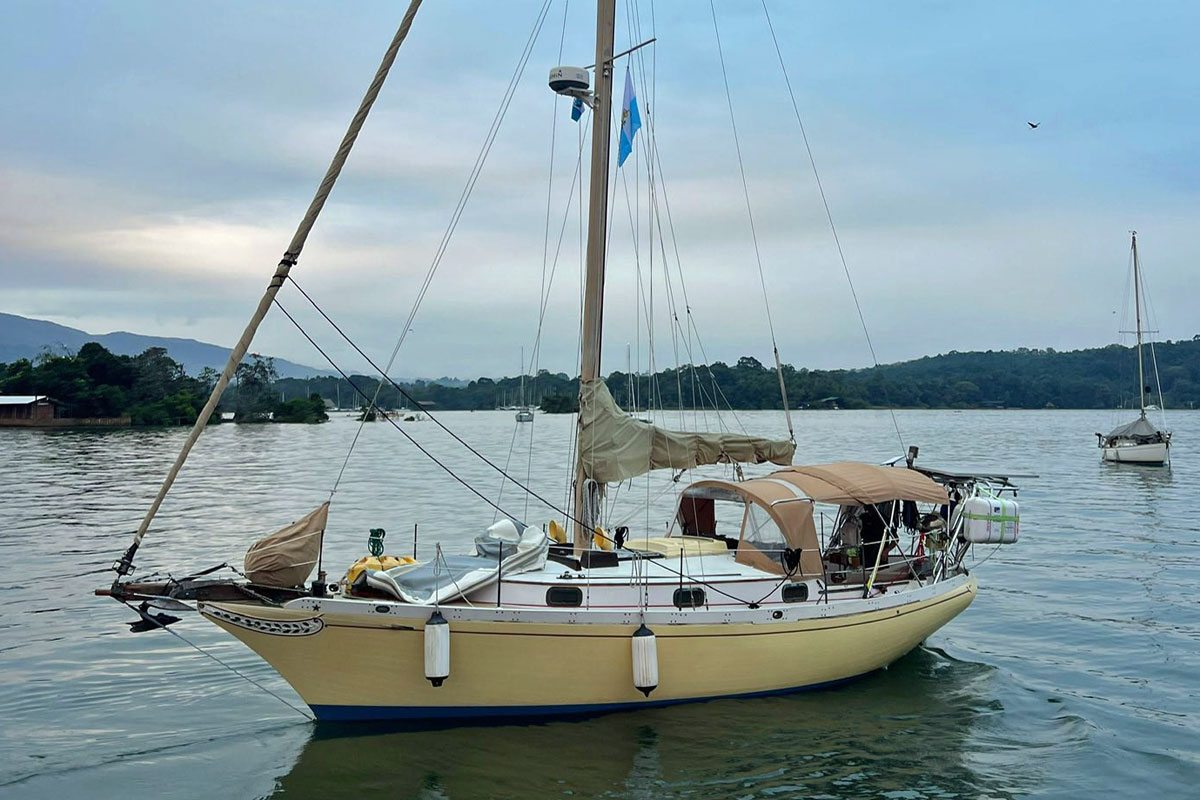
The Island Packet 445 sits near the top of Island Packet’s long‑keel cruising range, designed by Bob Johnson as a flagship offshore model. The hull is solid fibreglass with a long, full‑foil keel carrying lead ballast, and a fully protected spade‑type rudder hung on the trailing edge of the keel. This gives the boat the familiar Island Packet feel: strong directional stability, forgiving behaviour when pressed, and excellent protection for the running gear when grounding or in debris‑strewn waters. The deck is moulded fibreglass with a structural grid and substantial coamings; hull‑deck join is typically an inward flange bonded and mechanically fastened under the distinctive moulded rubrail.
Cabin side windows on the 445 are large, fixed units set into the moulded coachroof rather than small, individually through‑bolted frames. They are bonded and sealed into recesses, which reduces external fastener count but makes seal condition and any signs of crazing or leakage an important inspection point as the boats age. Opening portlights are framed metal units, through‑bolted and gasketed in the usual way.
Chainplates on Island Packets are internal, tied into substantial glassed‑in structures rather than simple deck‑mounted strap fittings. On later models such as the 445, the chainplates are stainless steel (transitioning to higher‑grade alloys over the years) and are bonded and laminated into the hull structure below the caprail, with the rig loads taken into the internal grid rather than the deck edge alone. This arrangement is structurally sound but makes inspection and replacement more involved; by now, many yards familiar with Island Packets regard proactive chainplate replacement as sensible insurance before serious ocean work.
The 445 is a centre‑cockpit design with a deep, secure cockpit and twin wheels, giving good access to the stern platform and aft cabin. Construction is robust rather than lightweight: dry displacement is around 34,500lb (15,649kg) with approximately 12,000lb (5,443kg) of lead ballast in the full keel.
There is a single keel configuration: long full keel with a published draft of about 5'0" (1.52m). There are no centreboard or twin‑keel variants. Rig is consistently a cutter, with self‑tacking staysail and furling headsail; most boats were delivered with in‑mast furling mainsails. Layouts vary between a two‑cabin, two‑head version and a three‑cabin, two‑head version, but the saloon, galley and navigation area remain broadly similar. Factory literature quotes a STIX (Stability Index) of 53, placing the boat comfortably within the offshore‑capable band for her size.
Published Specification: The Island Packet 445 Blueprint
| Specification | Value |
|---|---|
| LOA | 45'9" (13.94m) |
| LWL | 38'1" (11.61m) |
| Beam | 14'4" (4.37m) |
| Draft (max) | 5'0" (1.52m) |
| Displacement (dry) | 34,500lb (15,649kg) |
| Ballast | 12,000lb (5,443kg) lead |
| Rig Type | Cutter, masthead, in‑mast furling main (most boats) |
| Hull Material | Fibreglass (GRP), solid hull |
| Production Dates | 2004–2015 |
Sail Areas & Rig Dimensions
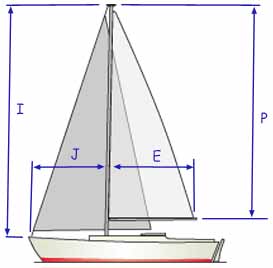 Rig dimensions
Published total working sail area for the Island Packet 445 is 1,074ft² (99.7m²), comprising the mainsail and a 100% foretriangle.
Factory and public databases do not consistently publish definitive I, J, P and E values for the 445, and even Keel Index notes that not all rig measurements are available. For a buyer, surveyor or sailmaker, the only fully reliable source is the original rig plan or a direct measurement of the spars and chainplate positions on the specific hull.
For practical purposes:
- Total working sail area:
1,074ft² (99.7m²) – main plus 100% foretriangle
- Mainsail area (approximate from typical Island Packet proportions): Around 400–430ft² (37–40m²) on an in‑mast furling spar
- Headsail / foretriangle area: Remainder of the 1,074ft², with many boats carrying a 135–150% genoa on a furler and a self‑tacking staysail
Because exact I, J, P and E are not consistently published, I would strongly recommend that any new sail order or rig modification be based on measured dimensions from the actual boat rather than generic data. That is a key accuracy point for this model.
Performance Analysis: Understanding the Design Ratios
| Ratio | Value | Interpretation |
|---|---|---|
| Sail Area / Displacement (SA/D) | ≈16.3 | Moderate sail power: capable of reaching hull speed in suitable conditions, but not a light‑air flyer. |
| Displacement / Length (D/L) | ≈279 | Heavy displacement: prioritises load‑carrying and comfort over acceleration and nimble handling. |
| Ballast / Displacement (B/D) | ≈34.8% | Moderate ballast: good overall stability, but the boat will heel and reward early reefing when pressed. |
| Capsize Screening Formula (CSF) | ≈1.76–1.8 | Below the 2.0 offshore threshold: geometry suitable for ocean passages and knockdown resistance. |
| Brewer Motion Comfort Ratio | ≈38 | Comfortable motion: steady, predictable behaviour in a seaway, well suited to multi‑day passages. |
In practical terms, these ratios paint a clear picture: the 445 is a heavy, comfortable cruiser with enough sail to keep moving, but she is not designed to be driven hard like a performance cruiser. She rewards conservative sail handling, carries stores well and looks after her crew when the sea state turns untidy.
For more on this topic, you might want to take a look at Understanding Boat Performance & Design Ratios...
How the Island Packet 445 Sails
Upwind, the 445 behaves like most full‑keel cutters: she tracks well, points adequately rather than sharply, and prefers a slightly cracked‑off angle to keep speed up. In moderate conditions, expect close‑hauled speeds in the 4–5 knot range, rising towards 6 knots on a tight or beam reach as the apparent wind builds. Keel Index’s performance estimates suggest around 4.5–4.7 knots close‑hauled in 15–20 knots of true wind, and up to 7 knots on a beam reach in stronger breezes, which aligns with owner reports.
The cutter rig comes into its own as the wind rises. With a self‑tacking staysail and a reefed main, the boat settles into a comfortable, slightly heeled stance and will keep plugging on without drama. Many owners comment that the boat feels happiest reefed earlier than a lighter design; the ballast ratio and hull form give plenty of stability, but the sail plan can heel her if carried too long. Early reefing keeps the helm light and the motion comfortable.
Downwind, the long keel and protected rudder give a steady, predictable feel. The boat is not prone to sudden broaches, but like any heavy cruiser she benefits from a balanced sail plan: a poled‑out genoa and staysail, or an asymmetric spinnaker in moderate conditions, will keep speeds in the 6–7 knot band without excessive rolling. The centre cockpit and twin wheels give good control and visibility, though the high freeboard means you are sailing from a relatively elevated position.
Helm feel is generally positive rather than feather‑light. The boat tracks strongly, and the rudder is well protected but not especially large, so fine trimming of sails pays dividends. Short‑handed behaviour is one of the 445’s strengths: electric winches on many boats, in‑mast furling and the self‑tacking staysail make it realistic for a couple to manage the boat on passage without needing to leave the cockpit frequently.
Motion is where the design ratios show their value. The comfort ratio in the high‑30s translates into a slow, predictable roll and gentle pitch, which is exactly what you want when crossing an ocean or living aboard at anchor. You will not win many races, but you are less likely to arrive exhausted.
Bluewater Capability: Strengths & Trade-Offs
The Island Packet 445 was conceived as an offshore cruiser, and the specification supports that role. Tankage is generous: around 160 US gallons (606L) of fuel and 260 US gallons (984L) of fresh water, plus a holding tank of about 55 US gallons (208L). This allows long passages and extended time away from marinas, especially when combined with modern upgrades such as solar, wind generation and watermakers.
Seakindliness is a core strength. The full‑foil keel, protected rudder and heavy displacement give a reassuring feel when crossing swell or dealing with confused seas. The CSF below 2.0 and STIX of 53 underline the boat’s suitability for offshore work. Deck safety is helped by the wide bow pulpit, substantial guardrails, moulded bulwarks and secure centre cockpit. Handholds are well placed, and the deep cockpit coamings give a sense of being “in” the boat rather than perched on top.
Load‑carrying is excellent. The D/L ratio near 280 means you can add cruising gear, spares and provisions without dramatically altering the waterline or trim. Many 445s have crossed oceans with full cruising inventories and still sat comfortably on their marks.
The trade‑offs are familiar to anyone who has sailed heavy full‑keel boats:
- Light‑air performance is modest; you may motor more than a lighter fin‑keel cruiser in marginal conditions.
- The 5'0" (1.52m) draft is not extreme, but combined with the long keel it limits access to some shallow anchorages and makes tight manoeuvring in marinas more deliberate.
- The heavy displacement and full keel mean the boat does not spin on a dime under power; bow thrusters are a common and sensible upgrade.
For bluewater work, though, these compromises are often acceptable, and many owners choose the 445 precisely because they value its conservative, seamanlike character.
Configuration, Layout & Cruising Characteristics
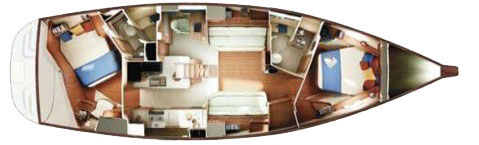 IP445 Layout Plan
The 445’s centre cockpit is deep and secure, with twin wheels and good protection from a hard or soft dodger. Primary winches are within reach, and the mainsheet and headsail controls are arranged to minimise the need to leave the cockpit. Side decks are wide, with substantial handrails and a broad bow pulpit that makes anchor handling safer.
Below, the boat feels more like a small floating flat than a stripped‑out yacht. Headroom in the saloon is quoted at up to 7'3" (2.2m), with around 6'6" (2.0m) elsewhere. The saloon has a large U‑shaped settee to starboard with a folding table that can stow against the forward bulkhead, and comfortable seating to port. Large fixed windows and numerous opening ports and hatches keep the space bright and ventilated.
The galley is a proper cruising galley: walk‑through layout, double sinks, substantial refrigeration (including a pull‑out refrigerated drawer), three‑burner stove with oven, microwave and plenty of storage. Countertops are solid acrylic with moulded sea rails, and there is a slide‑out rubbish bin and built‑in dish racks. It is clearly designed for cooking underway as well as at anchor.
The navigation station opposite the galley is a highlight: a high‑backed swivel chair, large chart table, good access to electrical panels and space for modern electronics. A wet locker nearby is a thoughtful touch.
Cabin arrangements vary. The standard layout is two cabins and two heads: a generous aft owner’s cabin with island berth, private head and separate shower, and a forward guest cabin with island berth and its own head. An optional three‑cabin layout adds a third cabin, typically forward, while retaining two heads. In both cases, berths are proper double islands with storage beneath, and there is ample hanging and locker space.
For liveaboard use, the combination of storage volume (factory literature quotes around 425ft³ / 12.0m³ of storage), tankage, comfortable cabins and a proper galley makes the 445 a very credible floating home.
Who This Boat Is Best For
Good fit for:
- Bluewater couples & families: Those planning ocean passages and extended cruising who value comfort, security and storage over speed.
- Liveaboard owners: Sailors intending to live aboard full‑time or for long seasons, needing proper cabins, a serious galley and generous tankage.
- Conservative sailors: Skippers who prefer predictable handling, strong construction and a full‑keel feel, and who are happy to reef early and accept modest passage speeds.
Less ideal for:
- Performance‑oriented sailors: If you enjoy tweaking sail trim to squeeze out every tenth of a knot or racing around the cans, the 445 will feel heavy and unhurried.
- Shallow‑water explorers: Cruisers who spend most of their time in thin‑water estuaries or tight, shoal‑draft anchorages may find the long keel and 5'0" draft limiting.
- Owners unwilling to tackle refit work: By now, most 445s are old enough that tanks, chainplates, portlights and systems need inspection and, in some cases, replacement. Buyers wanting “no projects” may struggle unless they find a boat with recent comprehensive refit.
The Buyer’s Checklist: Common Problem Areas
For a prospective buyer, the Island Packet 445 has a fairly predictable set of inspection priorities, many shared with other Island Packet models:
- Chainplates & rig attachment: Internal chainplates are robust but can suffer from stress‑crack corrosion over time. On boats approaching or past 20 years, many specialists recommend proactive replacement, especially before serious offshore work. Look for any signs of leakage at the caprail, staining, or previous repairs, and budget accordingly.
- Portlights & bonded windows: Leaking portlights and ageing seals around the large fixed cabin windows are a known issue on older Island Packets. Check for water staining, soft headliners, crazed acrylic and any evidence of previous resealing. Re‑bedding or replacement can be labour‑intensive.
- Aluminium tanks (fuel & water): Aluminium tanks have a finite life. Corrosion, especially where moisture and salt can sit against the tank, is a common problem. Inspect accessible tank surfaces, look for any signs of weeping or fuel odour, and be wary of tanks buried under sole panels without inspection hatches. Replacement can run from hundreds to several thousand pounds depending on access and fabrication.
- Electrical system & owner modifications: Age, moisture and DIY additions can leave the electrical system tired. Look for corroded terminals, non‑marine wiring, overloaded bus bars and ad‑hoc additions. A structured rewire or partial upgrade may be sensible.
- Deck hardware & sealants: Stanchion bases, cleats and other deck fittings rely on good bedding. Over time, sealants degrade and leaks can develop into core issues if not addressed. The 445’s deck construction is robust, but any signs of soft spots or movement around fittings should be investigated.
- Sails & rigging: Original in‑mast furling mains and headsails may now be at the end of their useful life. Standing rigging on a boat of this age should be assumed due for replacement unless documented otherwise. Factor in the cost of a full rigging and sail package if the boat has not been updated.
Typical refit costs for a 445 can vary widely, but as a rough guide:
- Chainplate replacement by a specialist yard: several thousand pounds.
- Full standing rigging replacement: mid‑four figures.
- New mainsail and genoa: mid‑four to low‑five figures depending on cloth and cut.
- Tank replacement: from £1,000 to £5,000+ depending on access and fabrication.
- Electrical tidy‑up or partial rewire: highly variable, but often a multi‑day job.
None of these are unique to the 445, but they are realistic items to budget for when assessing a boat in this age band.
Could this be your ideal cruising boat?
It may well be, but before going any further, it might be worth taking a look at my eBook 'How to Avoid Buying the Wrong Sailboat'...
Summing Up
The Island Packet 445 is very clear about what it wants to be. The design ratios, full‑keel hull, protected rudder and cutter rig all point towards a conservative, ocean‑capable cruiser that looks after its crew and carries its stores without fuss. She is heavy, comfortable and reassuring, with a motion that many long‑distance sailors will happily trade for a knot or two of speed.
On the downside, she is not a lively performer in light airs, and the long keel and displacement make tight manoeuvring and shallow‑water exploration more deliberate. Age‑related maintenance is now a fact of life: chainplates, tanks, portlights, rigging and systems all need honest appraisal and, in many cases, investment.
For the right owner—a sailor or couple who want a secure, comfortable platform for serious cruising and are prepared to engage with the maintenance reality—the Island Packet 445 remains a compelling option. She is not trying to be all things to all sailors; instead, she offers a well‑thought‑out, bluewater‑focused package that still stands up well in today’s market.
 DMcC
DMcCThis article was written by Dick McClary, RYA Yachtmaster and author of the RYA publications 'Offshore Sailing' and 'Fishing Afloat', member of The Yachting Journalists Association (YJA), erstwhile member of the Ocean Cruising Club (OCC) and owner/administrator of 'Liveaboard Sailboats for Sale'.

Frequently Asked Questions (FAQs)
1. How does the Island Packet 445 compare to other bluewater cruisers like the Hallberg‑Rassy 46 or Oyster 45 in passage‑making comfort?
1. How does the Island Packet 445 compare to other bluewater cruisers like the Hallberg‑Rassy 46 or Oyster 45 in passage‑making comfort?
The 445’s motion comfort ratio and full‑keel geometry put her firmly in the “steady, predictable” camp, comparable to other heavy cruisers, though with slightly more conservative performance than some semi‑modern fin‑keel designs.
2. What are the key refit priorities for a newly purchased Island Packet 445 intended for an Atlantic circuit?
2. What are the key refit priorities for a newly purchased Island Packet 445 intended for an Atlantic circuit?
Chainplates, standing rigging, sails, tanks and electrical systems are the main structural and systems priorities, followed by portlights, deck hardware bedding and modernising navigation and power generation.
3. How does the full‑foil keel of the 445 affect manoeuvrability in tight marinas compared with fin‑keel cruisers?
3. How does the full‑foil keel of the 445 affect manoeuvrability in tight marinas compared with fin‑keel cruisers?
The long keel improves tracking but reduces agility; the boat pivots more slowly and is more affected by prop walk, so bow thrusters and careful use of lines become valuable tools.
4. Is the standard tankage on the Island Packet 445 sufficient for long passages without a watermaker?
4. Is the standard tankage on the Island Packet 445 sufficient for long passages without a watermaker?
For a conservative crew, the 260 US gallons (984L) of water and 160 US gallons (606L) of fuel are workable for typical ocean legs, but many owners still choose to add a watermaker to reduce reliance on shore facilities.
5. How well does the cutter rig work for short‑handed sailing, and is there any downside to in‑mast furling on this boat?
5. How well does the cutter rig work for short‑handed sailing, and is there any downside to in‑mast furling on this boat?
The cutter rig is excellent for short‑handed reefing and balance, while in‑mast furling simplifies handling but can reduce mainsail shape and area; many owners accept that trade‑off for ease of use, especially on long passages.
Recent Articles


-
Should I Buy a Boat? Four Questions to Answer Before You Commit
Oct 02, 26 04:40 AM
Thinking "Should I buy a boat?" This guide helps you decide, with key considerations from cost & maintenance to your personal sailing aspirations. -
Offshore Internet with Starlink: Hardware, Plans, and Setup Guidance
Oct 01, 26 01:15 PM
A clear, practical guide to choosing the right Starlink hardware and plan for offshore cruising. Learn what to buy, how to install it, and how to manage power afloat. -
Offshore Liferaft Guide: Choosing, Stowing and Servicing One
Oct 01, 26 06:28 AM
Choosing an offshore liferaft? Learn what ISO 9650 Group A means, where to stow it, how often to service it and what to pack in the grab bag.