- Home
- Rigging
- Standing Rigging Inspection Checklist
- How Long Does Standing Rigging Last
How Long Does Standing Rigging Last? Age, Sea Miles and the Insurer's Rule
Key Takeaways: There is no single expiry date for standing rigging. Three clocks run at once. Age: around ten years is the usual rule of thumb for 1x19 stainless wire on a cruising boat, with five to seven years more realistic if the boat is sailed hard. Sea miles: Selden's guidance has been quoted at roughly 20,000 nautical miles for wire. Condition: a broken strand or a cracked terminal overrides both numbers. Insurers add a fourth clock of their own, and the age they care about varies widely, from about seven years to fifteen or more, with some policies naming no age at all. Work out which clock runs out first on your boat, ask your insurer in writing what they actually require, and keep a rigging log so you're never guessing.
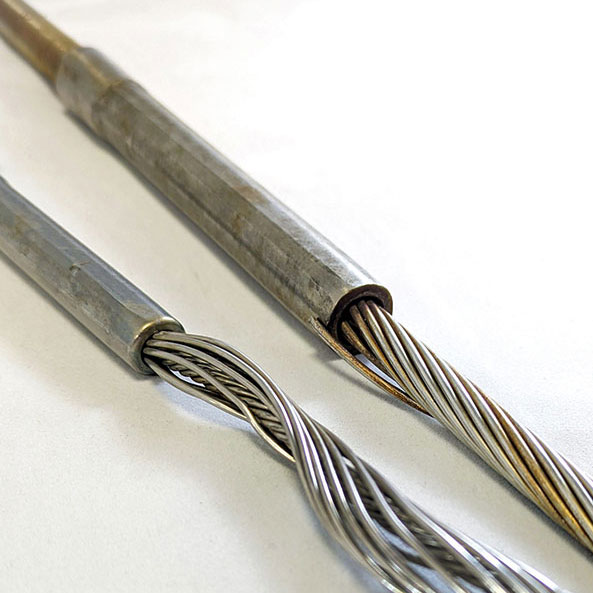 A broken strand at the terminal means replace now, whatever the age
Few questions divide sailors, riggers and insurers like this one. Ask three riggers how long standing rigging lasts and you'll get three answers, all of them reasonable.
This guide sets out what the numbers really mean, where they come from, and how to decide for your own boat. It's a companion to our main inspection guide, A Sailor's Checklist: Inspecting & Maintaining Your Standing Rigging, which covers how to carry out the inspections themselves.
Why There Is No Single Answer
Standing rigging doesn't wear out the way a sail does. Wire fails through metal fatigue, from the repeated loading and unloading of every tack and every wave, and through corrosion, particularly crevice corrosion hidden inside terminals where you can't see it. How fast those two processes work depends on the size of the wire relative to the loads it carries, the quality of the wire and fittings, how the rig is tuned, the climate you sail in and how hard you drive the boat.
That's why published guidance is so varied. Practical Sailor has pointed out that it has never seen empirical data behind the commonly quoted year figures, and that wire makers and coastguard guidance describe a service life that varies with the vessel's design and use. Treat every number in this article as a planning aid, not a pass mark.
It's also worth knowing that rigging ages while the boat sits still. Yachting press guidance makes the point that the rig is under load on a mooring too, so a boat that rarely sails isn't automatically a boat with young rigging.
The Three Clocks: Age, Sea Miles and Condition
Most of the confusion goes away once you treat age, miles and condition as separate clocks, and replace when the first one runs out.
| Clock | Typical Figure Quoted | What It Misses | Best Used For |
|---|---|---|---|
| Age | About 10 years for a cruising boat in moderate use; 5 to 7 years if sailed hard; 15 years is widely treated as an outer limit | How hard and where the boat has been sailed | Setting a budget and planning horizon |
| Sea miles | Roughly 20,000 nautical miles for wire, a figure attributed to Selden (earlier guidance said 25,000 or once round the world) | Years spent on a mooring or in a cradle with the mast stepped | Planning before an ocean passage or circumnavigation |
| Condition | No number: broken strands, cracks at terminals, rust weeping, cracked toggles | Internal fatigue and hidden corrosion that can't be seen from outside | Deciding to replace now, whatever the age or mileage |
| Insurer | Varies: about 7 to 10 years, 10 to 15 years, or no stated age | It's a risk rule, not an engineering one | Staying covered; what to ask for in writing |
Wire, Rod and Synthetic: Different Materials, Different Lives
The rules of thumb above are for 1x19 stainless wire, which is what most cruising boats carry. Rod and synthetic rigging don't follow the same pattern, and for both of them the manufacturer's schedule matters more than any general figure.
| Material | Life Guidance | What to Watch |
|---|---|---|
| 1x19 stainless wire | Around 10 years typical for cruising; riggers often start to consider replacement as it approaches 15 | Broken strands (often called fishhooks or meat hooks), cracks at swage terminals, rust staining at fittings |
| Rod | No single figure; follow the maker's schedule. Often a shorter interval than wire | Fatigue in the cold-formed heads, little visual warning, tune matters a great deal; needs specialist inspection |
| Synthetic (Dyneema and similar) | No single figure; follow the maker's schedule | Chafe, UV degradation, creep or slippage at terminations; repairs need specialist materials |
The Insurer's Rule: What It Really Says
The "ten-year rule" is usually quoted as if it were written into every policy. It isn't. Published guidance describes wide variation across the market, with stipulations ranging from about seven to ten years, through ten to fifteen, to policies that don't mention rig age at all. In practice, the age trigger often arrives by a different route. A surveyor writes that rigging more than ten years old should be replaced, and the insurer then offers cover provided the survey recommendations are carried out. Owners have also reported insurers who set no age limit but would be unlikely to pay out on a failure judged to be down to age.
Insurers who do publish a rule tend to tier it. One insurer's published guidance asks for a rigger's or specialist's check once the rig is more than 15 years old, and replacement if the boat is over 25 years old with the original rig. In both cases the boat can still be insured, but rig damage is excluded until the check or replacement is done. Treat that as one example of how a policy can work, not as a standard.
Also bear in mind that planned ocean passages can change the requirements, and that you should declare them. The sensible approach is to stop relying on rumour and put the questions to your own insurer, in writing:
- Does the policy state a maximum rig age, and where is it in the wording?
- What evidence is accepted: an invoice, a rigger's certificate or a survey?
- What happens at renewal if the rig is over the stated age?
- Is rig damage excluded or limited until the rig is inspected or replaced?
- Are rod and synthetic rigs treated differently from wire?
- Do planned ocean passages change any of this?
Our guide to yacht insurance covers the wider picture of what policies do and don't cover.
Buying a Used Boat: Reading the Rigging History
This is where the age question costs real money. If the rigging is original, the previous owner may have inherited the problem and be passing it on to you. Ask for the rigging's provenance: invoices, the rigger's name, the date of replacement and the wire and terminal types used. A boat with no paperwork should be treated as having rigging of unknown age, and the price should reflect that.
Remember too that a pre-purchase survey isn't a rigging survey. Most surveyors don't go aloft or dismantle fittings, so if the rig is anywhere near the ten-year mark, a separate rigger's inspection is money well spent. Our sailboat survey checklist and guide to buying a used sailboat explain where rigging fits into the wider inspection, and our look at the true cost of boat ownership is a reminder to budget for a re-rig early.
Signs You Should Replace Now, Whatever the Age
Age and mileage are planning tools. These are decision tools:
- Any broken strand in a wire, particularly where it enters a terminal.
- Cracking across the shoulder of a toggle or at the mouth of a swage terminal.
- Rust weeping from a terminal or staining that wasn't there last season.
- A bulge, bend or distortion in a swaged fitting.
- Evidence of corrosion or movement at the chainplates.
When you do re-rig, many riggers replace the wire together with its terminals, toggles and turnbuckles rather than reusing old fittings on new wire, and check the chainplates while the rig is down. Ask your rigger what they recommend for your boat and why.
Keeping Track and Making the Rig Last
You can't change the age of your rigging, but you can improve how well you understand it. Start a rigging log in the boat's logbook or a simple spreadsheet, recording wire type and diameter, installation date, who did the work, tension settings and the findings of each inspection. Over ten years, memory isn't reliable.
Keep the rig properly tuned, since slack leeward shrouds accelerate fatigue, and rinse and check fittings regularly. Pair your own seasonal checks with a rigger's mast-up inspection every three to five years and a full mast-down inspection around the ten-year mark, as described in our main inspection guide.
Summing Up
Standing rigging doesn't come with a single expiry date, and anyone who offers you one is simplifying. Treat age, sea miles and condition as three separate clocks, replace when the first one runs out, and remember that a broken strand beats every rule of thumb. Find out what your insurer actually requires rather than what the pontoon says, ask for the rigging history before you buy a used boat, and keep a log so that your decisions rest on records. If you're approaching ten years, or planning an ocean passage, a rigger's inspection is cheap compared with the cost of a dismasting.
Frequently Asked Questions
Does my insurer really require standing rigging to be replaced every ten years?
Does my insurer really require standing rigging to be replaced every ten years?
Not necessarily. Ten years is the figure most often quoted, but insurers vary. Published examples range from about seven to ten years, ten to fifteen, and some policies name no age at all. Often the trigger is a survey recommendation or a condition at renewal rather than a line in the policy. Read your wording and ask your insurer in writing.
Do I have to replace all the standing rigging at once?
Do I have to replace all the standing rigging at once?
Many riggers prefer to do the full set together, because the wires have all had the same life and it's one job with the mast accessible. Staged or rolling replacement is possible if the older wires are inspected closely and your insurer accepts it. When a wire is replaced, the terminals and fittings at its ends are usually replaced with it.
Should I re-rig before an ocean passage or circumnavigation?
Should I re-rig before an ocean passage or circumnavigation?
If your rig is approaching ten years old, or has been sailed hard, a mast-up inspection by a rigger is the minimum before an ocean passage, and many cruisers choose to re-rig first. A single long passage can use a large share of the mileage guidance, and your insurer may want planned passages declared.
I only sail at weekends. Can I keep my rigging beyond ten years?
I only sail at weekends. Can I keep my rigging beyond ten years?
Possibly, if a rigger finds it sound and your insurer is content. But rigging ages on a mooring as well as at sea, and corrosion and fatigue don't depend only on miles. Treat the ten-year mark as a trigger for a closer professional inspection, not as a licence to stop looking.
Is rod rigging replaced more or less often than wire?
Is rod rigging replaced more or less often than wire?
There's no single figure. Rod gives fewer visual warnings, can suffer fatigue in its cold-formed heads, and makers and insurers often set shorter intervals than they do for wire. Follow the manufacturer's schedule for your rod and book specialist inspections rather than relying on your own eyes.
Recent Articles


-
Swage or Mechanical Rigging Terminals? Spot Failure Early
Nov 20, 26 04:06 PM
Swage terminals can crack out of sight. Learn the warning signs, how dye testing helps, and when Sta-Lok or Norseman fittings are the better choice. -
Wauquiez Pilot Saloon 60 Review, Specs & Bluewater Buying Guide
Nov 20, 26 09:01 AM
Detailed Wauquiez Pilot Saloon 60 review covering specs, performance, seaworthiness, ownership, buyer checks and bluewater cruising suitability. -
Wauquiez Pilot Saloon 60 for Sale
Nov 20, 26 07:56 AM
Designed by Ed |Dubois, 'Alligator Uno' is a large, comfortable pilothouse cruising yacht built in 1994 with a fibreglass hull.