- Home
- Cruising Yachts 45' to 50'
- Jeanneau Sun Odyssey 45.2
The Jeanneau Sun Odyssey 45.2 Sailboat
Specs, Performance Analysis & Cruising Characteristics
Key Takeaways
The Jeanneau Sun Odyssey 45.2 is a quintessential example of the "performance cruiser" era of the late 1990s, offering a high-volume hull that remains surprisingly agile. Designed by Philippe Briand, it is known for its light to moderate displacement, a versatile sail plan, and an interior that comfortably accommodates liveaboard sailors. While its capsize screening ratio suggests it is more of a coastal and offshore cruiser than a dedicated southern ocean storm-buster, its build quality—incorporating Kevlar reinforcement—and its twin-wheel cockpit make it a durable and ergonomic choice for blue water passage-making.
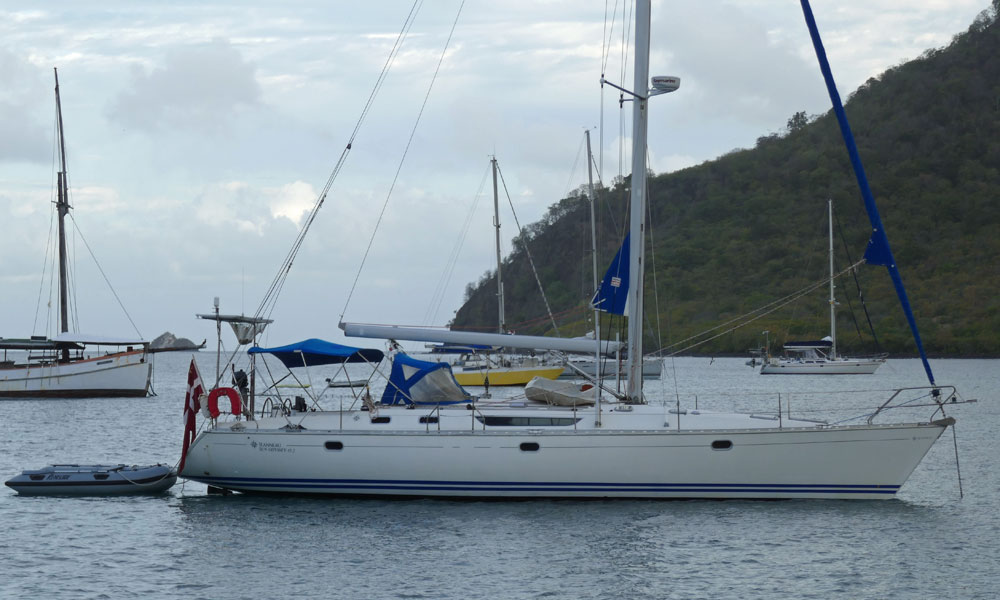 A Jeanneau Sun Odyssey 45.2
Table of Contents
Design & Construction
The Jeanneau Sun Odyssey 45.2 was born from the drawing board of Philippe Briand, a designer renowned for blending racing pedigree with cruising comfort. Produced by Jeanneau in France between 1997 and 2003, the hull is constructed from solid hand-laid fibreglass (GRP) below the waterline, while the deck utilizes a balsa core for stiffness and weight reduction. A notable structural detail is the inclusion of Kevlar in the bow sections, providing additional impact resistance for offshore encounters.
A defining feature of this model is the implementation of twin steering wheels. While common today, this was a forward-thinking move in the late nineties for a boat of this size. Practically, this design opens a clear central walkway from the companionway to the reverse transom, facilitating easy access to the water or a dinghy. This configuration also allows the helmsman to sit well out on the side deck for a better view of the tell-tales and oncoming waves, without the need for a single, oversized wheel that would obstruct the cockpit.
The yacht was offered in several configurations to suit different markets. While most are masthead sloops, buyers could choose between a standard draught fin keel of 6'7" and a shallow draught version at 5'3". The latter is particularly popular in areas with restricted depth, such as the Bahamas or the East Coast of the United States. Internally, the boat was produced in an "Owner" version with three cabins and a "Charter" version featuring four cabins, illustrating its versatility as both a private home and a high-occupancy cruiser.
Published Specification: The Jeanneau Sun Odyssey 45.2 Blueprint
| Specification Parameter | Measurement & Detail |
|---|---|
| Length Overall (LOA) | 46'5" |
| Length at Waterline (LWL) | 38'5" |
| Beam | 14'8" |
| Draught (Standard / Shallow) | 6'7" / 5'3" |
| Displacement | 9,800 kg (21,605 lbs) |
| Ballast | 3,675 kg (8,102 lbs) |
| Rig Type | Masthead Sloop |
| Hull Material | GRP (Fibreglass) & Kevlar |
| Production Dates | 1997 - 2003 |
Performance Analysis: Understanding the Design Ratios
To evaluate how the 45.2 handles at sea, we must look at the mathematical relationships between its dimensions. These figures provide an objective look at performance and stability.
| Design Ratio | Calculated Value | Performance Implication |
|---|---|---|
| Sail Area / Displacement (SA/D) | 20.7 | High: Indicates strong light-air performance. |
| Displacement / Length (D/L) | 170 | Light/Moderate: A quick hull that planes easily. |
| Ballast / Displacement (B/D) | 37.5% | Stable: Good resistance to heeling. |
| Capsize Screening Formula (CSF) | 2.11 | Moderate: Standard for beamy modern cruisers. |
| Brewer Motion Comfort Ratio | 22.8 | Moderate: Motion may be "lively" in heavy seas. |
Interpretation of Ratios
The Sail Area / Displacement ratio of 20.7 places the Sun Odyssey 45.2 firmly in the category of a spirited cruiser. It has enough canvas to keep moving in light Mediterranean or Caribbean breezes where heavier boats might be forced to motor. However, this also means that the boat can become overpowered quickly, necessitating early reefing as the wind climbs above 15 to 18 knots.
The Displacement / Length ratio of 170 confirms that Philippe Briand designed a relatively light hull for its length. This is excellent for speed and surfing downwind, but it also means the boat's performance is sensitive to being overloaded with heavy cruising gear. For those planning long-term circumnavigations, careful weight management of water, fuel, and spares is essential to maintain its sailing characteristics.
Regarding stability, the Capsize Screening Formula of 2.11 is slightly above the traditional offshore benchmark of 2.0. This is largely due to the generous 14'8" beam. While it provides immense interior volume and initial stability (it won't heel much in light air), sailors should be aware that in extreme ocean conditions with breaking waves, the boat's width makes it slightly more prone to remaining inverted if rolled compared to a narrow, heavy-keeled blue water specialist.
For a deeper dive into how these metrics influence your time on the water, see our guide on Understanding Boat Performance & Design Ratios.
Advanced Analysis & Context
The choice of GRP as the primary hull material, enhanced by Kevlar reinforcement in the bow, represents a pragmatic middle ground for the recreational sailor. Unlike aluminium hulls, which offer ultimate impact resistance but require meticulous electrical isolation to prevent galvanic corrosion, the GRP hull of the 45.2 is relatively low-maintenance and familiar to any boatyard worldwide. The Kevlar "collision mat" provides some peace of mind when navigating waters where containers or debris might be a risk.
The key defining feature—the twin-wheel steering—does more than just improve cockpit ergonomics. It also provides a level of redundancy. Most 45.2 models utilize a single quadrant, but having two wheels allows for more varied steering positions, which reduces helmsman fatigue during long passages. However, owners should note that the placement of the primary winches is somewhat forward of the helms. While this is great for a full crew, it makes single-handed tacking more reliant on the autopilot to hold the course while the sailor moves forward to manage the sheets.
Configuration, Layout & Cruising Characteristics
The 45.2 is celebrated for its linear galley on the port side. This layout provides a vast amount of counter space and makes it possible for multiple people to work in the saloon area without tripping over the cook. The U-shaped seating to starboard is spacious, easily seating six to eight people for dinner.
Cruising practicalities are well-addressed with significant tankage. With up to 600 litres of water and 205 litres of fuel, the boat is capable of extended periods away from the dock. The cockpit is another highlight; the large table with integrated storage is the focal point of life at anchor. Storage is also plentiful, with "gull-wing" lockers in the cockpit and a large lazarette between the wheels, though some owners find the anchor locker can "pile up" chain if not monitored during retrieval.
One specific area for maintenance focus is the upper rudder bearing. Forums and owner associations have noted that the original galvanised steel bearing carrier can be prone to rust if water sits in the housing. Many owners choose to replace this with a custom stainless steel or bronze version to ensure long-term reliability.
If you wish to compare this boat with others within this size range, take a look at Cruising Sailboats from 45' to 50' Overall.
Summing Up
The Jeanneau Sun Odyssey 45.2 is a balanced yacht that successfully straddles the line between a comfortable Mediterranean charter platform and a capable offshore passage-maker. Its design ratios highlight a boat that is fast and rewarding to sail, particularly in light to moderate conditions, though its lively motion in a seaway and light displacement require a proactive approach to reefing. While it may lack the heavy-duty "go-anywhere" tank-like construction of an aluminium expedition yacht, its Kevlar-reinforced hull and immense interior volume make it one of the best value-for-money cruisers in the 45-foot second-hand market. For a couple or a family looking to cross oceans with style and speed, the 45.2 remains a formidable contender.
This article was written by Dick McClary, RYA Yachtmaster and author of the RYA publications 'Offshore Sailing' and 'Fishing Afloat', member of The Yachting Journalists Association (YJA), and erstwhile member of the Ocean Cruising Club (OCC).
Could this be your ideal cruising boat?
It may well be, but before going any further, it might be worth taking a look at my eBook 'How to Avoid Buying the Wrong Sailboat'...
Frequently Asked Questions (FAQs)
Is the Jeanneau Sun Odyssey 45.2 suitable for a solo circumnavigation?
Is the Jeanneau Sun Odyssey 45.2 suitable for a solo circumnavigation?
While it is often sailed short-handed, the winch placement and light displacement make it more of a challenge for solo sailors compared to a dedicated blue water boat. However, with a reliable autopilot and lines led aft, many have successfully completed long solo legs.
What should I look for during a pre-purchase survey?
What should I look for during a pre-purchase survey?
Pay close attention to the upper rudder bearing carrier for signs of corrosion and inspect the teak decks (if fitted) for thinning or failing sealant. Additionally, check the keel bolts and the hull-to-deck joint for any signs of stress or movement.
How does the shallow draught version compare in sailing performance?
How does the shallow draught version compare in sailing performance?
The shallow draught version (5'3") carries more ballast to compensate for the higher centre of gravity. It is slightly less "stiff" than the deep fin version and will have a larger leeway angle when sailing upwind, but it is a necessary trade-off for cruising in shallow regions.
Can the 3-cabin version be converted to a 4-cabin layout?
Can the 3-cabin version be converted to a 4-cabin layout?
The 4-cabin version was usually built with a removable longitudinal bulkhead in the forward cabin. If you have the 3-cabin "Owner" version, it typically features a permanent large forward stateroom that is not easily subdivided without significant joinery work.
What is the typical engine configuration for this model?
What is the typical engine configuration for this model?
Most 45.2s are powered by a Yanmar diesel engine, typically the 4JH series (roughly 56hp to 75hp). These are considered highly reliable and have a well-established global parts network, which is vital for cruising sailors.
Recent Articles


-
DSC Radio Guide: Setup, MMSI & Pushbutton Distress Calls
Apr 25, 26 02:57 AM
Learn how to set up and use a DSC radio for emergency distress calls, MMSI registration, and routine marine communication. -
The Bayfield 40 Sailboat
Apr 13, 26 05:09 AM
An expert review of the Bayfield 40 staysail ketch. Explore technical specs, design ratios, and real-world cruising performance for this classic full-keel voyager. -
Understanding Boat Performance Ratios & How to Use Them
Apr 12, 26 06:46 PM
Master the essential yacht design ratios including D/L, SA/D, and the Comfort Ratio to accurately compare sailboat performance and stability.

Copyright © 2026 Dick McClary Sailboat-Cruising.com